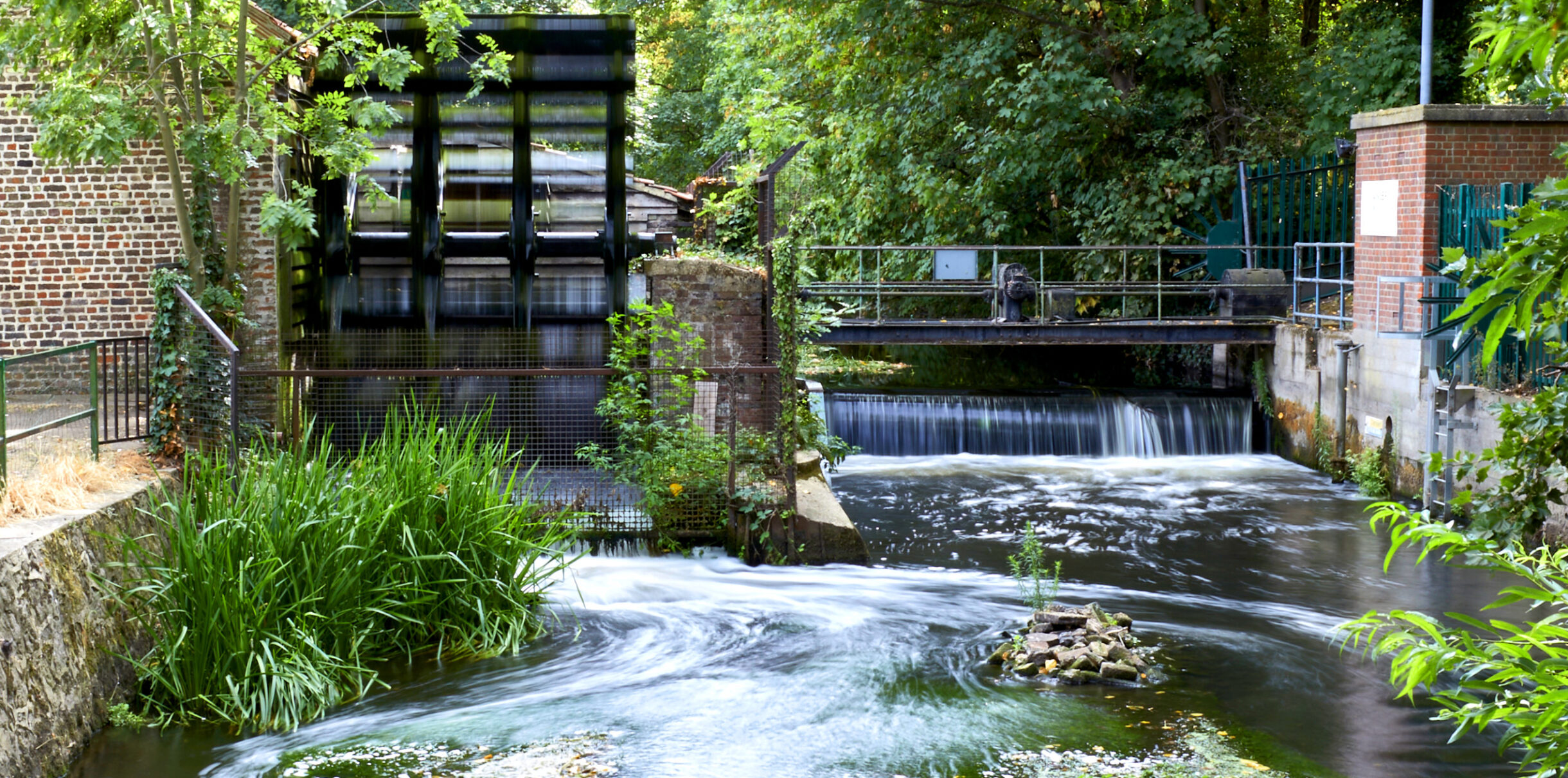
About Merton Abbey Mills
“Imagine, by the Wandle’s side, an old walled garden. On the banks, long, low-roofed worksheds, and a waterwheel revolving at its ease; long strips of printed cotton a-rinsing in the stream; great hanks of yarn, fresh from the indigo vat, hung, drying in the air; dyers and printers moving easily about – in all, a sunlit picture of most peaceful work.”
Description of Merton Abbey in 1900

The biggest priory in the country
Merton Abbey Mills takes part of its name from Merton Priory, one of the most important monasteries of the middle ages. Merton Abbey or Priory as it was known, was an Augustinian Priory built in the early 12th century. Henry III’s queen, Eleanor of Provence and King Henry VI were both crowned here whilst Thomas Becket and Walter de Merton (founder of Merton College Oxford) were both educated here.
The priory was surrendered to the crown in 1538 during the Dissolution under Henry VIII. Although most of its buildings were demolished, some remain standing today.
By 1600, textile mills were attracted to the River Wandle, not only as a source of power but also because of the special quality of its water, a chalkstream ideally suited to the washing, dyeing and printing of textiles. By 1792 over a thousand people were employed by the various print works or associated businesses in the area and The River Wandle was one of the hardest working rivers in the whole of Europe.
Once established in the Wandle Valley, the printing industry attracted skilled workers from all over the UK, several important advances in the technique of printing textiles were developed here. The huge steampowered mills of the Midlands dominated the industry in terms of mass production, the Wandle Valley textile industry led the way in quality and innovation. For centuries afterwards it was a centre for the manufacture and printing of textiles, and until 1970 was the silk-printing works of the famous Regent Street store Liberty’s. The ‘Showhouse’ adjacent to Merantum way being so named as it was constructed for the showing of the fabrics created at the mills, Left derelict for nearly twenty years it was restored in 1989 as a visitor centre, arts and crafts market and venue for cultural entertainment, since when it has become one of South London’s major regeneration successes with up to half a million visitors a year.
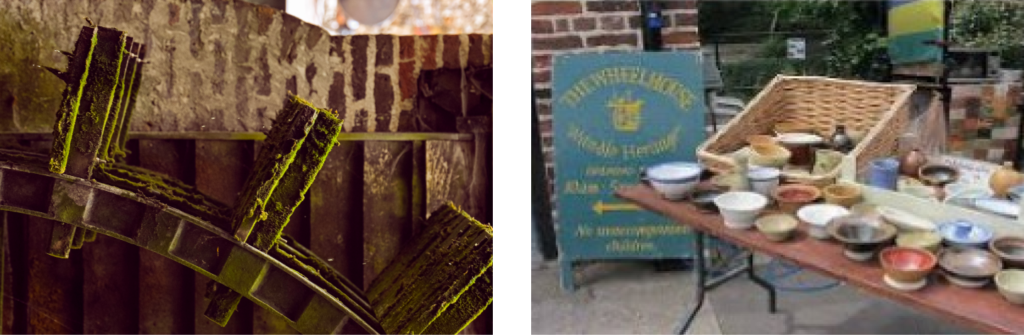
The Wheelhouse
Two hundred years ago there were nearly 100 watermills on the River Wandle. Only four still survive: Grove Mill Carshalton, The Snuff Mill and Ravensbury Mill at Morden. The wheel here at Merton Abbey Mills is the only one in full working order. The Wheel is of the undershot type, with the current flowing beneath. It dates from 1885, though there were previous mills on the same site for hundreds of years before then. Liberty’s used it for rinsing the gum off the printed silk, and inside you can still see the spools it powered.
Nowadays the Wheelhouse is a pottery workshop and gallery, and the wheel is used to turn the potter’s wheel. The Waterwheel now turns five days a week from Wednesday – Sunday and visitors are free to wander into the old Wheelhouse building and see it working for themesleves. It also generates electricity and powers other machinery including a lathe and its own self-lubricating device. The Wheelhouse is maintained by the volunteers of Wandle Heritage Ltd, a charitable company supported by The London Borough of Merton.
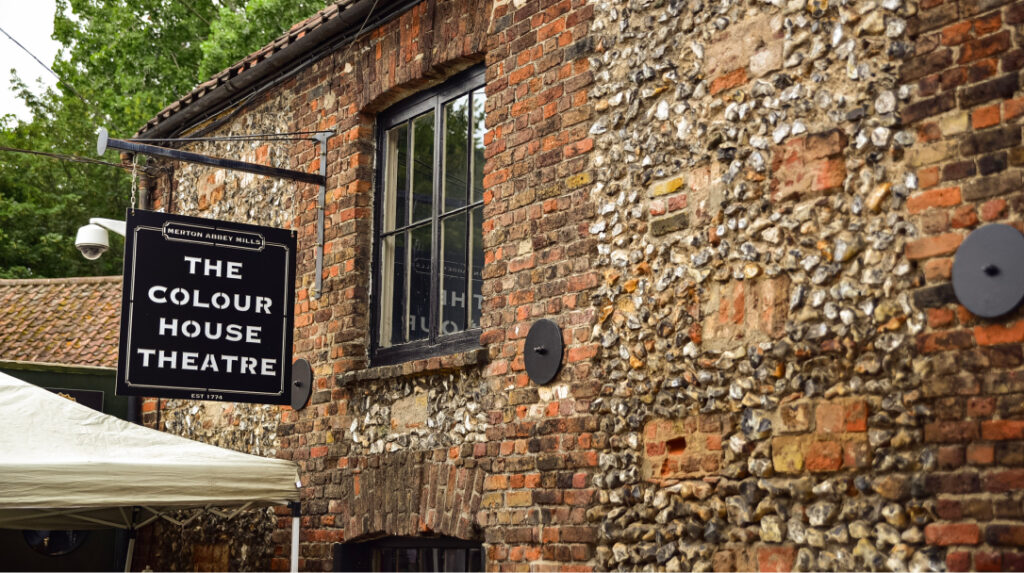
Colour House Theatre
The site’s most ancient building, probably the only remaining part of the medieval Merton Priory. Colour House Theatre is Grade II listed and is the oldest building on the site. It is believed that some elements of the building may have come from the Priory itself. In places there is a chequered patterning which is a typical Tudor feature, in the stone block and flint work.
Photographic records indicate that it once had two floors and the upper floor held some kind of winding apparatus. The dye vats, being of considerable weight, would have been set on the ground floor. The fabrics were dipped into these.